“A Big Book”
Newgrange decoded
Was Newgrange a “big book”
to illustrate the meditation system
as taught by the Buddha?
Newgrange decoded
Was the mound of Newgrange in Ireland a Buddhist Stupa designed to illustrate the meditation system as taught by the Buddha in India in the 6th century BC?
Did the installation of coded rocks with engravings follow a mnemonic well known in Europe for up to 1,800 years to illustrate the meditation system taught by the Buddha?
If the Greek philosophers – “one who loves wisdom” – were followers of the Buddha then metempsychosis taught by Pythagoras was the equivalent of Dependent Origination and the Four Great Elements – earth, water air and wind – an essential meditation technique taught by the Buddha that was repeatedly described by Plato in his dialogues, containing details about particles in space only a successful practitioner can know.
In the text it will show that Greek philosophers were followers of the Buddha and that Newgrange was designed as a “big book” where the installation of rocks with engravings marked by the sun was designed as a carefully calibrated clockwork to illustrate the meditation system originally taught by the Buddha.

Was Newgrange Neolithic, built 5,000 years ago?
Peat, the organic material used to keep rocks in place when building the mound of Newgrange, was carbon dated in 1962 after excavations started when the technique was still very young.
Peat only forms at 1 millimeter per year, if cut at a depth of 3 meters the peat would already be 3,000 years old.
The age of the peat cannot be used to establish the age of construction of the installation of rocks at Newgrange, which cannot be carbon dated.
If not Neolithic was Newgrange built as a Buddhist stupa to illustrate the meditation system taught by the Buddha – ‘in 3D plus time’?
Is it still possible to find a date for the installation of the passage of Newgrange? The entire installation point towards a construction date after the 6th century BC.
The installation of rocks in the Great Circle, the Kerbstones and in the Orthostats in the Passage at Newgrange followed a very specific numerical order: these numbers are still recognisable.
The same numbers were used to teach the meditation system of the Buddha Gotama from India since the 6th century BC, known as “the mystic numbers of Pythagoras”.
Pythagoras was the first to call himself a “philosopher – one who loves wisdom”. Pythagoras (c.580-500 BC) was younger than the Buddha (624-544 BC), he taught “metempsychosis” – to see past lives to render future life happy through purification of the mind – the equivalent of “Dependent Origination” taught by the Buddha.

Was Newgrange a Buddhist Stupa comparable to stupas in Asia?
Our latest and best photos
Ramagrama Stupa Nepal 6th century BC
Photo Sukrat Gaud
Dowth Ireland
Photo Yvonne Ní Mhuiregán
Newgrange
after watercolour 1889
copy Setti Wessels
Kathmandu Ashoka stupa 250 BC
Kathmandu Boudhanath stupa c. 600 CE
Circumambulation Boudhanath stupa
The Newgrange mound is unique in the world: an illustration of ‘exterior materiality’ and ‘interior mind’.
The installation at Newgrange is unique in the world: the mound’s exterior was a metaphor for ‘Ultimate Materiality, rūpa’ and the interior an illustration of ‘Ultimate Mentality, nāma’.
The exterior is an illustration of theory of the meditation system to visitors, Dependent Origination,, the interior passage of Newgrange illustrates the steps followed by a meditators to analyse death and rebirth as taught by the Buddha. with the concentrated 6th sense, the ‘light of wisdom’.
Exterior:
the meditation system to see Dependent Origination, Causes that result in Effect, rebirth
Interior:
meditator’s investigation of death and rebirth to attain liberation
Winter solstice event: Rebirth
The ‘light of wisdom’ of the concentrated 6th sense.
Sunlight in the passage illustrates a meditator’s concentrated mind, the 6th sense.
The light stops in front of Orthostat L32 (32 Marks of a Great Man, the Buddha) and the Central Chamber is illuminated to illustrate Four Noble Truths: to attain liberation.

The main event of Newgrange is the winter solstice when sunlight enters through the roof-box and stops in front of Orthostat L32 to identify the presence of the Buddha himself, described in a famous Pali text of the Tripitaka: ’32 Marks of a Great Man’.
The chambers light up, all illustrations that describe the steps to attain enlightenment are illuminated, the four massive cornerstones are the Four Noble Truths: 1st Noble Truth to see Suffering, 2nd Noble Truth to see Causes Suffering, 3rd Noble Truth to see Cessation of Suffering and the 4th Noble Truth to see the Path that leads to the Cessation of Suffering.

Newgrange winter solstice
National Monuments Service Ireland
Video clip of the Newgrange winter solstice light in the passage by the National Monument Service Ireland.
12 stones of the Great Circle: Dependent Origination, (‘metempsychosis’ in Greek)
Despite the idea of having a complete circle of 36-38 standing stones there was no evidence of more than 12: the ’12 Dependent Origination factors’ to investigate past, present and future lives, the equivalent of ‘metempsychosis’ as taught by philosopher Pythagoras in the 6th century BC.
The 12 stones were arranged in recognisable coded groups that represent further meditation concepts in the meditation system.

Dependent Origination (factor 12) Anekajati Pali chanting
A short clip of factor 12 of Dependent Origination, the Anekajati Pali chanting by Pa Auk Sayadaw from the documentary Sketch of an Excellent Man. The documentary is available in 14 translations including western languages: Spanish, German, Russian, Lithuanian. www.settiwessels.com
Outer ring with 97 Kerbstones
The Newgrange mound is surrounded by 97 kerbstones of up to 4.5 meters long and on average 1 meter in height.
Complex engravings are found especially on the left side of the passage entrance on the face of stones, some are below ground level and some on the rear of the stones.
By following the numerical order of images imprinted in soft clay on the Phaistos Disk of Crete as ‘chapter headings’ that define the topic, the abstract symbols of the engravings can still be translated as they explain meditation techniques taught by the Buddha and described in the Pali Tripitaka texts.

How to read the Rocks and Engravings:
numbered rocks as the topic (like chapter headings) and simple shapes as gestures to express ideas (like text)
TOPIC: Firstly the rocks followed a mnemonic of numbers originally illustrated on the Phaistos Disk by pictures, the ‘master key’, the numbers represent recognisable concepts or meditation techniques in Buddhism, for example 6 = 6 senses, 8 = 8-fold Noble Path etc.
TEXT: Secondly the abstract symbols were used to make the engravings on rocks were not phonetic but ‘ideograms’, easily recognisable shapes similar to hand gestures, pointing at something, a ‘universal language of the heart’. They form patterns that can be interpreted as meditation instructions when the topic is known.
TOPIC: Firstly the rocks followed a mnemonic of numbers

TEXT: Secondly the list of abstract symbols for engravings

Newgrange
translation of
97 kerbstones
The 97 kerbstones at Newgrange were translated, rocks had a number as a topic that is used to translate engravings as meditation instructions. PDF text available online.

List of all Kerbstones
West side
North side
East side
Group of 8 on right side of entrance
Ring of 97 Kerbstones site layout: codes to describe the meditation system
The Newgrange mound can be decoded using positions and numbers of the 3 highly decorated ‘marker stones’: K1, K52 and K67.
On the left side are the codes for meditation instructions as taught by the Buddha starting with K1, (5 clinging aggregates). On the north side K52 represent investigation of Ultimate Mentality 52 Cetasika, mental factors, and from there K89 with 89 Citta, mind. K67 is the ‘Teacher Stone’ that faces east, instructions to attain liberation are highlighted during the summer solstice.

‘Marker stones‘ K1, K52 and K67
Some kerbstones are famous for the high quality and complexity of engravings, such as K1, K52 and K67 – these stones mark special combinations through which the meaning of the installation can be decoded.
Kerbstone 1 marks the main entrance into the passage, the 5 spirals identify one of the most essential terms taught by the Buddha, to see “Ultimate Reality of mind and materiality, the 5 clinging aggregates”: 1. Materiality and Mind four mental factors 2. feeling 3. perception 4. formations and 5. consciousness.

5 clinging aggregates
A short video clip with animation timing 00.39.30 from the documentary ‘Sketch of an Excellent Man’ where a master meditation teacher, the Pa Auk Sayadaw, explains the meditation system that was originally taught by the Buddha in India.
Famous Kerbstone K1 at the entrance: the key to wisdom is knowledge of the
“5 clinging aggregates”
Kerbstone K52 exactly opposite K1k: analysis of mentality, 52 Cetasika
Kerbstone K67 evidence of the Teacher

Newgrange translation of Winter solstice, summer solstice and equinox events
During the winter solstice, summer solstice and equinox events some rocks of the Great Circle cast shadows on carefully designed selections of kerbstones to mark special events, these days would have been used for festivals or teaching students about the meditation system.
PDF text available online.

SPECIAL NOTE
Each kerbstone was chosen individually for size and fitted around the mound aligned with other rocks and the sun to create a carefully calibrated clockwork that illustrates the meditation system.
Newgrange winter solstice and equinox shadows of Rocks 1 to 5 on kerbstones at the passage entrance
The illustration on the image ice truly profound, an example of the sophisticated design found at Newgrange: the winter solstice and equinox shadows of Rocks 1 to 5 on specially planned kerbstones at the passage entrance.
On the illustrations are the rocks marked by the shadows of the sun during the winter solstice around 21/22 December.
The combination shows rocks with a special relationship that will result in liberation from the shackles that keep us tied to rebirth in samsara, the goal illustrated by Rock 5 (5 clinging aggregates) that was cut to a short size on site, its shadow would have been aligned with Kerbstone K13 that has its engraving on the back of the rock. Rock 5, the ‘journey of life’ must be cut – illustrated on the back of K13.
The rocks were all illustrated in the PDF text available online.
The rocks were all illustrated in the PDF text available online.

Newgrange codes of winter solstice, summer solstice and equinox shadows around the mound and special marker stones K1, K52 and K67.
The marker stones K1, K52 and K67 and shadows form special codes all round the mound that is like a carefully calibrated clockwork that explains the meditation system all year round.
The mound’s east side is all about enlightenment, note that it also faces Dowth on the east side with a similar winter solstice event but in the evening. The two mounds communicate (see pdf text for a detailed explanation).

Newgrange translation of 60 Orthostats in the passage
The 60 orthostats in the passage of Newgrange were translated, rocks had a number as a topic that is used to translate engravings as meditation instructions.
PDF text available online.

Newgrange plan and sections with mnemonic of numbers and images as found on the Phaistos Disk
On the plan is the layout with codes and engraved rocks marked in green.
On the right side of the passage the images and numbers illustrated the path to be followed by the meditator, engravings on each number that defines essential meditation techniques have detailed instructions that can still be translated because the techniques are still practiced unchanged after 2,600 years.
On the left side of the passage the images and numbers illustrated the instructions of the Teacher who knows the way.

Newgrange passage with sections to illustrate the application of the mnemonic of numbers and images as illustrated on the Phaistos Disk
On the left side of the passage the images and numbers illustrated the instructions of the Teacher who knows the way, the first engraving is only found on Orthostat L12, ’12 Dependent Origination Factors’ as taught by the Buddha.
On the right side of the passage the images and numbers illustrated the path to be followed by the meditator, engravings on each number that defines essential meditation techniques have detailed instructions that can still be translated because the techniques are still practiced unchanged after 2,600 years.

Examples of orthostats
Our latest and best photos
We love to take pictures and show them to the world.
L32: ’32 Marks of a Great Man’, the Buddha
R21: 6 senses, ‘enlightenment stone’
L19: Seven Stages of Purification
Chamber 3 ‘gateway to wisdom’
Chamber 3 ceiling overview of system
Central chamber: Four Noble Truths
L25: spirals path to end kamma – 6 senses
R18: 18 Dhātu, elements that cause rebirth
Passage with overview of engravings
Newgrange was designed using a mnemonic that was known in Europe for up to 1,800 years:
‘Mystic numbers of Pythagoras’ used as a mnemonic to teach meditation illustrated on the Phaistos Disk
There is only one person from the 6th century BC still famous as a mathematician and as the first to use the word “philosopher, one who loves wisdom” – Pythagoras.
The series of “mystic numbers” – most likely introduced by Pythagoras – follows the same order as the meditation system taught by the Buddha. The numbers were introduced as a mnemonic in Europe to teach the meditation system of the Buddha and was used until 1,800 years later by Dante Alighieri to compose his famous Divine Comedy, one of the greatest masterpieces of European writing.
With the use of the Phaistos Disk the installation and engravings at Newgrange can still be analysed in detail.
Phaistos Disk Master Key: a tool to teach meditation
Animated text video clip, no sound.
47 symbols were imprinted repeatedly on a 15 cm oval clay disk in a seemingly chaotic mix, but with careful observation intricate patterns with multiple layers of knowledge appear. When following lines in the clay that link clusters of symbols, threads of information reveal a network of knowledge that was well known and practiced in Europe for at least 1,800 years.
Not limited by language barriers images were used to create “mathematical formulas” compatible with the meditation system taught by the Buddha Gotama in India in the 6th century BC and introduced into Greece by Pythagoras, mathematician and the first to call himself “a philosopher: one who loves wisdom”.
Phaistos Disk images as a mnemonic to teach Buddhist meditation
The Roman author Porphyry (232-303 CE), Neoplatonist philosopher in Rome, wrote a biography, “Life of Pythagoras” in which he described the knowledge of Pythagoras who was the most likely person to have designed the Phaistos Disk:
12. In Egypt he lived with the priests, and learned the language and wisdom of the Egyptians, and three kinds of letters, the epistolic, the hieroglyphic, and symbolic, whereof one imitates the common way of speaking, while the others express the sense by allegory and parable.
List of 47 symbols that appear on the Phaistos Disk
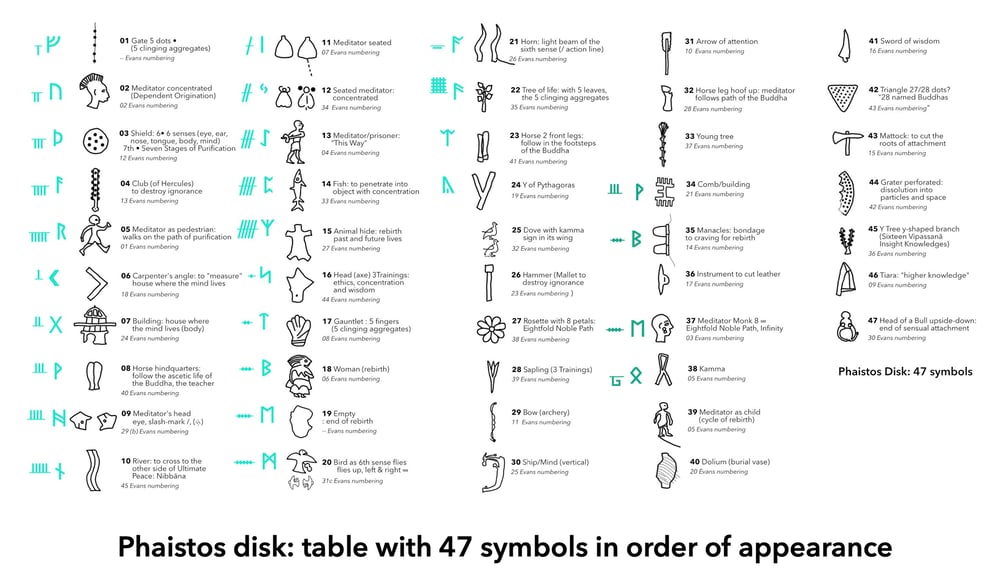
Use of Phaistos Disk images
The original images on the Phaistos Disk were pressed into wet clay but were replaced eventually by simplified abstract ‘ideograms’ that were easier to use, first the Ogham Hand Signs and later the Scandinavian Runes. The system of numbers to illustrate meditation stayed unchanged.
Example: meaning of symbols on the Phaistos Disk

Philosophers – “Yonas” from Ionia – start colonies all over Europe
There is only one person from the 6th century BC still famous as a mathematician and as the first to use the word “philosopher, one who loves wisdom” – Pythagoras.
The series of “mystic numbers” – most likely introduced by Pythagoras – follows the same order as the meditation system taught by the Buddha. The numbers were introduced as a mnemonic in Europe to teach the meditation system of the Buddha and was used until 1,800 years later by Dante Alighieri to compose his famous Divine Comedy, one of the greatest masterpieces of European writing.
Nalanda University India
The Nalanda University in India was started in the 6th century BC by Venerable Sariputra, one of the two Chief Disciples of the Buddha.
In Records of the Western Regions the 19-year-long journey in 629–645 CE of Chines monk and travel writer Xuanzang described that the Nalanda University had 10,000 students from all over the world, including from Turkey on the Anatolian Coast.